In 2026, businesses are no longer relying solely on traditional websites. While websites are essential for visibility and lead generation, many companies are now investing in custom web applications to handle operations, automate workflows, and scale more efficiently.
The shift is simple. As businesses grow, generic tools and static websites start to limit what they can do.
The Problem with “One Size Fits All” Tools
Most businesses start with off the shelf solutions such as spreadsheets, CRMs, booking tools, or plugins. These work in the beginning, but over time, they create friction.
Too many tools that do not connect
Repetitive manual work
Limited customization
Data scattered across platforms
Inefficient workflows
At a certain point, businesses realize they are adjusting their operations to fit the tool instead of the tool fitting their business.
What Is a Custom Web Application?
A custom web application is a system built specifically for how your business operates.
Instead of forcing your workflow into a template, everything from dashboards to automations is designed around your exact processes.
This can include:
Client portals
Booking and scheduling systems
Internal management dashboards
Inventory and order tracking
Workflow automation systems
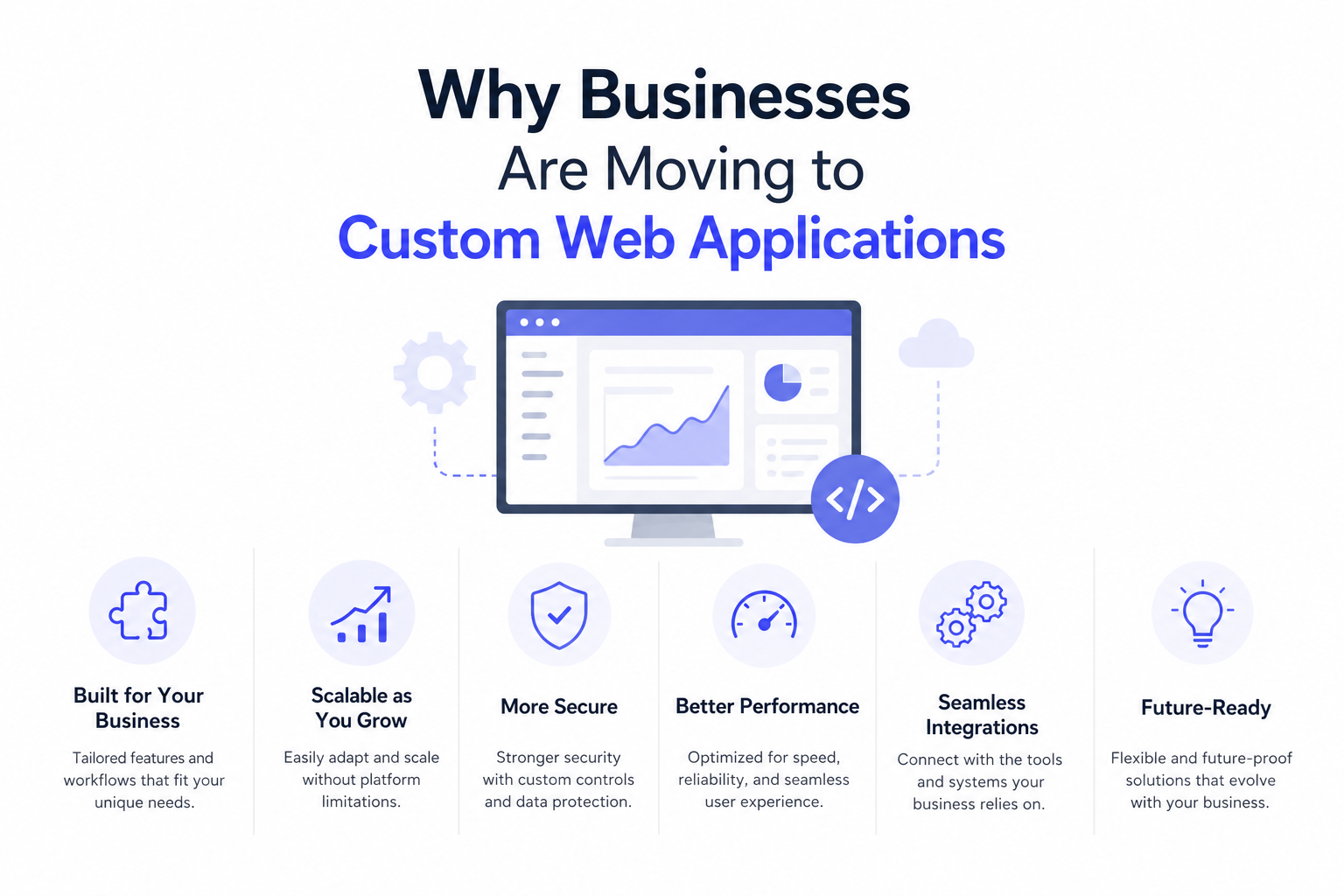
Why Businesses Are Making the Shift
1. Efficiency Through Automation
Custom web applications eliminate repetitive tasks.
Instead of manually updating spreadsheets or sending follow ups, businesses can automate:
Lead tracking
Status updates
Notifications and reminders
Report generation
This reduces errors and frees up time for higher value work.
2. Centralized Data
One of the biggest advantages is having everything in one place.
No more switching between tools. Your data, reports, and operations live inside a single system. This leads to better decision making, real time insights, and cleaner, more reliable data.
3. Built for Your Workflow
Every business operates differently. Custom applications are designed around your exact process, not a generic structure.
This results in faster execution, fewer unnecessary steps, and a system that actually makes sense to your team.
4. Scalability
As your business grows, your system grows with you.
Unlike pre built tools that become limiting, custom applications can expand, handle increased workload, and adapt to new services or processes.
This makes it a long term investment rather than a temporary solution.
5. Better User Experience
Whether it is for your customers or your internal team, a custom system is easier to use because it is designed with intention.
For customers, it creates smoother interactions, faster processes, and a more personalized experience.
For teams, it simplifies workflows, reduces training time, and increases productivity.
6. Competitive Advantage
Most businesses still rely on standard tools. A custom web application gives you something others do not have. A system tailored to how you operate.
This can lead to faster service delivery, more efficient operations, and a stronger overall customer experience.
When Should a Business Consider It?
You do not need a custom web application on day one. But it becomes worth considering when your operations are becoming complex, your team relies heavily on manual processes, you are using multiple disconnected tools, or you are starting to feel operational bottlenecks.
If your systems are slowing you down, it is a clear sign you have outgrown them.
Conclusion
Websites help businesses get discovered. Custom web applications help businesses run better.
As companies aim to scale, improve efficiency, and create better experiences, the move toward custom systems is no longer optional. It is strategic.
Businesses that invest early in the right systems do not just keep up. They operate faster, smarter, and more efficiently than their competition.