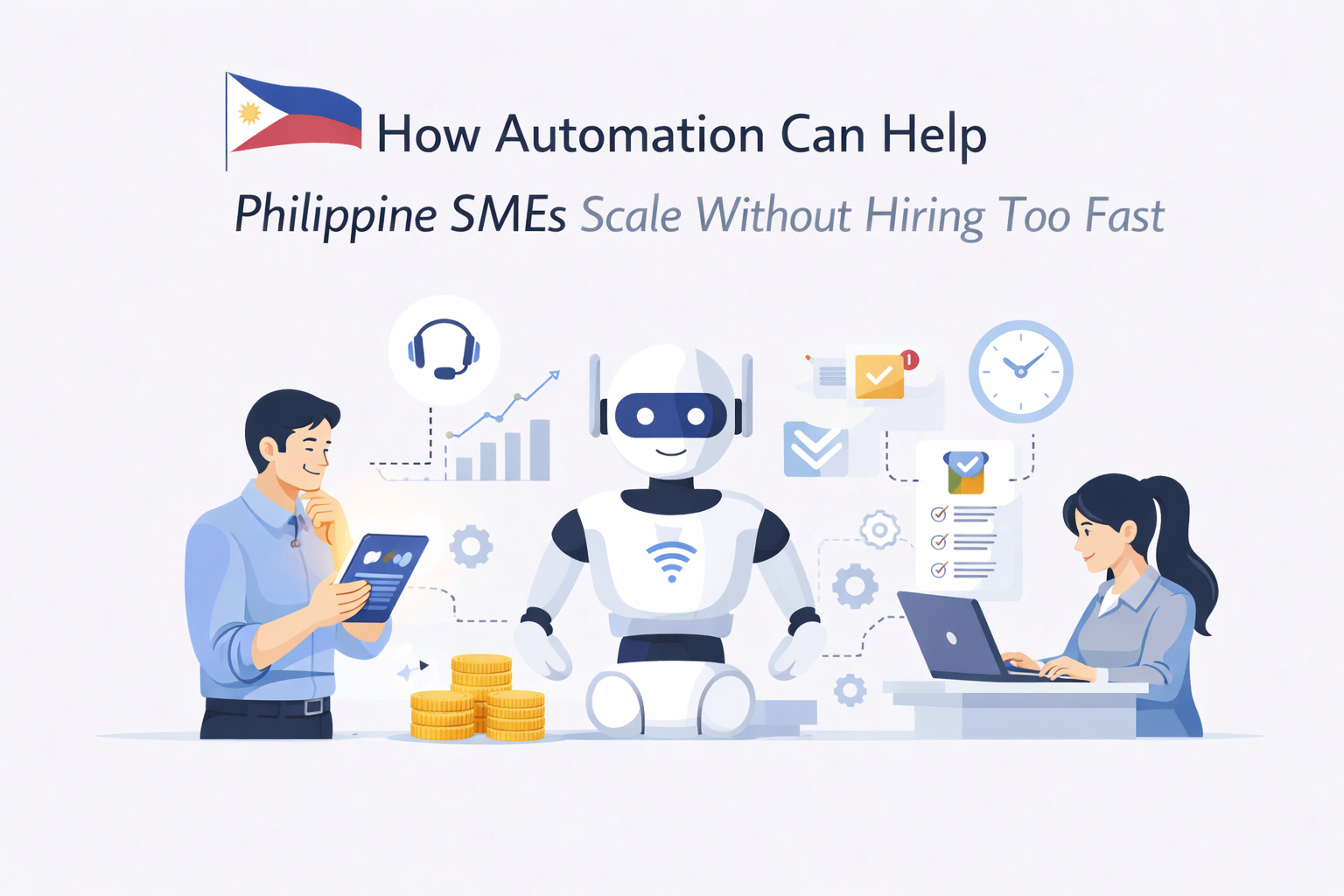
For many small and medium enterprises (SMEs) in the Philippines, growth presents a common challenge: operations start to strain before staffing can keep up.
Hiring more employees seems like the obvious solution. But in practice, this approach is expensive, time-consuming, and often inefficient.
The smarter solution is automation — leveraging technology to handle repetitive tasks, optimize workflows, and allow teams to focus on growth-driving activities.
For Philippine SMEs, automation is not just a tool — it is a strategic approach to scaling efficiently, reducing costs, and maintaining quality as operations expand.
What Is Business Automation?
Business automation refers to the use of technology to execute recurring tasks and processes automatically, without constant human intervention.
Automation is not about replacing people. It’s about enhancing productivity, improving accuracy, and enabling businesses to operate at scale without proportional increases in staffing.
Examples of automation include:
- Automating client onboarding processes
- Routing leads automatically to the right salesperson
- Sending email follow-ups and reminders
- Generating financial reports
- Streamlining internal approval workflows
When applied thoughtfully, automation allows Philippine SMEs to focus human resources on strategic work, while technology handles repetitive or time-consuming tasks.
Why Philippine SMEs Need Automation
The Philippine business environment is highly competitive, with SMEs often operating with limited resources. Automation helps overcome these constraints by:
Reducing Human Error
Manual tasks are prone to mistakes, which can damage client relationships or slow down internal processes. Automation ensures accuracy in tasks like invoicing, data entry, and reporting.
Improving Operational Efficiency
Automated workflows save hours of work every week, freeing employees to focus on activities that directly contribute to revenue growth.
Scaling Without Proportional Hiring
Many SMEs experience growing demand faster than they can hire. Automation allows businesses to handle higher workloads without expanding headcount.
Maintaining Consistency
Processes like client communication, follow-ups, and service delivery are standardized, ensuring consistent quality across all operations.
Increasing Agility
Automated systems can respond quickly to changes in workflow or demand, enabling SMEs to scale faster and more flexibly than competitors relying solely on manual processes.
Real-Life Examples of Automation for Philippine SMEs
Here are practical applications relevant to Philippine businesses:
Client Onboarding
- Automate form submission, account creation, and welcome emails.
- Ensures clients are guided smoothly through initial steps, reducing staff time and errors.
Lead Management
- Automatically assign leads to the right sales representative based on region, product interest, or urgency.
- Tracks lead progress without manual updates, improving conversion rates and response times.
Booking and Appointment Scheduling
- Schedule confirmations and reminders are sent automatically.
- Reduces no-shows and administrative overhead for service-based SMEs.
Payment and Invoice Automation
- Automatically issue invoices and follow-up reminders.
- Improves cash flow and reduces delays caused by manual billing processes.
Reporting and Analytics
- Generate weekly or monthly performance reports automatically.
- Management teams can focus on decision-making rather than compiling data.
These examples show that automation is not just a productivity tool — it is a strategic enabler for growth in the Philippine SME context.
Common Challenges SMEs Face When Implementing Automation
While automation is highly beneficial, Philippine SMEs often encounter challenges during implementation:
Over-Automation
- Automating too many processes at once can make operations rigid and impersonal.
- It’s important to balance efficiency with human touch, especially in client-facing interactions.
Lack of Strategy
- Implementing automation without understanding business needs may create bottlenecks elsewhere.
- SMEs must identify high-value processes where automation provides the greatest impact.
Choosing the Wrong Tools
- Expensive, complex, or incompatible software can be counterproductive.
- Businesses need solutions that integrate seamlessly with their existing systems and workflows.
Resistance to Change
- Staff may be hesitant to adopt new automated systems.
- Clear communication, training, and demonstrating benefits can improve adoption rates.
How Automation Supports Sustainable Growth
Automation is a growth multiplier for SMEs:
- More clients without more staff: Handles increased workloads without proportionally expanding human resources.
- Faster processes: Reduces delays and improves operational efficiency.
- Higher quality and consistency: Minimizes errors in data entry, reporting, and client communication.
- Strategic focus: Frees employees to focus on innovation, service improvement, and customer satisfaction.
- Competitive advantage: Businesses can scale faster and operate more efficiently than competitors relying solely on manual processes.
Why Partner with High6 for Automation
High6 helps Philippine SMEs implement automation strategically.
We offer:
- Custom websites and platforms with built-in automation workflows
- Integration-ready systems connecting CRM, payment gateways, and internal tools
- Scalable solutions designed to grow with your business
- Optimized performance, security, and reliability
At High6, automation is not just technical implementation — it is a strategic tool that enables growth, reduces overhead, and improves operational excellence.
Final Thoughts
Hiring more staff is not always the first step when your business grows.
For Philippine SMEs, automation offers a smarter path:
- Streamlines repetitive tasks
- Reduces human error
- Improves operational efficiency
- Supports sustainable scaling
- Frees employees to focus on strategic initiatives
When applied thoughtfully, automation allows SMEs to grow faster, operate more efficiently, and maintain quality, all without overextending resources.
For growth-focused Philippine businesses, automation is not optional. It is a critical part of a long-term growth strategy.